Monday, July 31, 2006

That's Where She Gets It From!

From The following exercise at the Soul Food Cafe
Box of Chocolates
‘Lessons and Philosophy from the Bear of Very Little Brain’


http://www.outbackonline.net/choc%20box/choc_pooh.htm
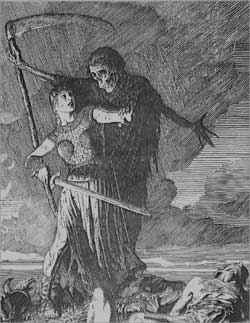


Fe, fa, fi-fo-fum

I smell the breath of an Englishman

Let him be alive

or let him be dead

I’ll grind his bones to make my bread


And wrapped around these Merry Little Lines was a tale about Cannibalism, Breaking and Entering (or as they refer to it on the Cop shows “ B & E”) and cold blooded murder (okay, I’d settle for Manslaughter. Or would it be Giant Slaughter?) Regardless, that Giant wouldn’t have ended up dead at the foot of the beanstalk had a certain little Englishman not been snooping around places he didn’t belong!

Back to the story…before I learned to read my Mom use to buy me these children’s books called “ Golden Readers”. They were easy to read (and by that I mean easy for the Parents to read.) The Fairy Tales were written at about an eight year olds reading level.Back in the day they were nice little books- I still have a few of them on my bookshelf. They were bound with string, not glue or paste and the pictures were wonderful.

Lots of detail, no pastels and they didn’t use block type. So no matter how little you were you felt like you were reading a ‘big kid’s book’.

And if you couldn’t read you may have done what I did: I use take the books and make my own story up to fit the pictures.

The thing is I ALWAYS saw more then what was actually there and by the ripe old age of five I was already addicted to a TV show called Nightmare Theatre. They played old horror and ghosts films every Friday and on Saturday afternoon they had a matinee.

I guess you can see where this is going…

Jack and the Beanstalk? Ha, How’s about Jack the Little Ripper?

I hated Jack.

He was mean and sneaky and remember the Harp calling out for the Giant? I thought she wanted to stay and I just knew that little Jerk Jack was going to take her down the Beanstalk and she would never see her castle again (well, that’s how I told it.)

I would read about Jack throwing all the stuff he stole from the castle down the beanstalk and just before he gets caught the last time he slides down the beanstalk, grabs an axe and he starts chopping and hacking until down comes the beanstalk and before you can say ‘busted’ the Giant crashes after it and dies.

So in the end Jack is sitting at this table and the harp is crying and Jack’s Mom is serving him stew (which I was convinced contained some Giant along with the chickens he stole…why NOT eat the Giant? He ate everything else he lifted from the Castle!)

Remember Jack swinging the axe? I do, I can still see it. So how does it end?

The last picture in the book is of Jack at the table with the stolen harp and the chunky stew.

That picture finally got to me in a big way.

I remember taking my little copy of Jack and The Beanstalk and tossing it under my bed where it STAYED.

That’s right…everytime I found it on my bookshelf or in my toy box I’d take that sucker and throw it under my bed because everytime I saw it I could hear that line over and over…the only one I remembered after my Mom read me the book (which I didn’t buy for a minute that malarkey she read was true)

Fe, fa, fi-fo-fum

I smell the breath of an Englishman

Let him be alive

or let him be dead

I’ll grind his bones to make my bread


It was never a Giant’s Voice I heard when I ‘read’ my little Golden Book. It was always a kid’s voice, a little boy’s voice. It was laughing the entire time and it wasn’t a happy laugh.

Fe, fa, fi-fo-fum

Wednesday, July 12, 2006

"The Real Dread Pirate Roberts" (Inspired by The Pirates of the Caribbean 2)

Last night the History Channel premiered an interesting documentary on The True Caribbean Pirates, and, naturally because Jon is on the island that was once Hispañola (now the Dominican Republic and Haiti), and because we recently saw The Pirates of the Caribbean 2, I wanted to see it and who they showcased in the documentary. Of course, they had the inescapable, infamous and oft-mentioned pirates. You know, Blackbeard, Henry Morgan, Anne Bonny, Calico Jack(?)... And they named a few that were reportedly famous, dangeous and highly feared--but I'd never heard of them. Like Black Bart Roberts, for instance, whom I like to refer to as..."The Real Dread Pirate Roberts."

I had no idea he existed, but mmmaann he was ruthless, merciless and the most successful pirate ever in the Golden Age of Piracy. On par or more with Blackbeard, and I'd always thought Blackbeard was the biggest and most frightening scourge of the sea! But it appears Roberts was.

The Real Dread Pirate Roberts was born in Pembrokeshire, Wales, May 17, 1682. At the age of 37, while the third mate on board the slave ship, The Princess of London, pirates overcame the ship and forced him into piracy because of his skills as a navigator. Six weeks later, after the death of Captain Howell Davis in battle, the pirates elected him as their new captain, and he accepted. His first act as a pirate captain was to lead his crew back to El Principe to avenge the death of their old captain. Under the cover of darkness, he and his crew landed on the island, attacking and killing the majority of the male population and stealing all items of worth they could carry. Though his career as a pirate was short--only four years long--Roberts, as I said before, was the most successful. He captured a remarkable total of 456 ships, once twenty-two at a time. He raided off the coasts of Africa, Brazil, and Newfoundland; and I think, was said to dress in scarlet red.

He was also atypical for a pirate.

  • He was a teetotaler; he preferred tea instead.
  • He loathed drunkeness and louts, cruelty and profanity.
  • He was always well-dressed.
  • He had excellent manners.
  • He forbade excessive gambling between his crew.
  • He held Sunday worship service onboard ship.
  • He was always clean-shaven.
  • He treated those he met with the utmost kindness and respect. (Uh...oook? Maybe those not victims of his acts of piracy?)
  • He had excellent, beautiful handwriting.
  • Being a lover of music, he had on board hired musicians.
Black Bart, in accordance with his "gentlemanly" ways, wrote 11 Shipboard Articles, or his own "pirate code of conduct" in 1721.
  1. Every man shall have an equal vote in affairs of moment. He shall have an equal title to the fresh provisions or strong liquors at any time seized, and shall use them at pleasure unless a scarcity may make it necessary for the common good that a retrenchment may be voted.

  2. Every man shall be called fairly in turn by the list on board of prizes, because over and above their proper share, they are allowed a shift of clothes. But if they defraud the company to the value of even one dollar in plate, jewels or money, they shall be marooned. If any man rob another he shall have his nose and ears slit, and be put ashore where he shall be sure to encounter hardships.

  3. None shall game for money either with dice or cards.

  4. The lights and candles should be put out at eight at night, and if any of the crew desire to drink after that hour they shall sit upon the open deck without lights.

  5. Each man shall keep his piece, cutlass and pistols at all times clean and ready for action.

  6. No boy or woman to be allowed amongst them. If any man shall be found seducing any of the latter sex and carrying her to sea in disguise he shall suffer death.

  7. He that shall desert the ship or his quarters in time of battle shall be punished by death or marooning.

  8. None shall strike another on board the ship, but every man's quarrel shall be ended on shore by sword or pistol in this manner. At the word of command from the quartermaster, each man being previously placed back to back, shall turn and fire immediately. If any man do not, the quartermaster shall knock the piece out of his hand. If both miss their aim they shall take to their cutlasses, and he that draweth first blood shall be declared the victor.

  9. No man shall talk of breaking up their way of living till each has a share of 1,000. Every man who shall become a cripple or lose a limb in the service shall have 800 pieces of eight from the common stock and for lesser hurts proportionately.

  10. The captain and the quartermaster shall each receive two shares of a prize, the master gunner and boatswain, one and one half shares, all other officers one and one quarter, and private gentlemen of fortune one share each.

  11. The musicians shall have rest on the Sabbath Day only by right. On all other days by favour only.
It was only a year later in February of 1722 that his (relatively) young life was cut short. (He was in his early 40s, remember.) Captain Roberts was killed instantly off of Cape Lopez, Gabon, by cannon grapeshot, which caught him in the throat while he and his crew battled Captain Chaloner Ogle's man-of-war, the HMS Swallow. Ogle had been sent to West Africa to capture and arrest pirates. It was Robert's long-standing wish to be buried at sea, thereby avoiding any capturing and displaying of his body by the victor. So, mere minutes after his death, his crew threw a sheet over him and bound his body in chains, throwing it overboard. (His skeleton most likely resides in chains and a sheet on the bottom of the ocean floor somewhere still today.) Fifty-two of his 254 pirate crew were hanged after the battle. His motto was "A merry life and a short one." It has been speculated since that most of his crew was drunk when the Man-of-war came upon them.


One of Black Bart's two flags.

Seafaring Legends (Inspired by The Pirates of the Caribbean 2)

For the most part, the teasers and trailers for the show reveal Captain Jack Sparrow has a debt to pay to Davy Jones, and that price or debt is his very soul. *voice goes very deep and eeerie on that last word* Nnoo, not Davy Jones from The Monkees--ha ha ha--but the infamous Davy Jones of "Davy Jones' Locker."

In the movie, Davy Jones and his oceanic undead crew manned the phantom ship, The Flying Dutchman. They also had control of the...Kracken...the horrifying mythical sea monster, whom they summoned to destroy any ship on which any particular captain, crew or individual sailor who had dared incur Jones' wrath was.


Also for the movie, the writers had created their own history or legend for Davy Jones. Not knowing that much about him, but being familiar with the phrase:
    "He's gone to Davy Jones' Locker!"
and knowing what it means, and also knowing something about the Flying Dutchman, their (the writers') mish mash of sailor lore had me wonderin'--yes, *half smile* my mind is almost always comin' up with new questions--and wanting to know more about both. Er, Davy Jones and the Flying Dutchman, of course. Sssoo here we are!

Watching the movie, and knowing the lil I knew about each--the captainship of Davy Jones of the Flying Dutchman didn't ring true--I wanted to find the truth and separate the two legends. According to a recent article in the Hartford Courant newspaper by Susan Dunne, Davy Jones is a spirit of the briny deep who lives on the ocean floor, gathering the bodies of those who die at sea into his locker. He's "'the fiend that presides over all the evil spirits of the deep, and is often seen in various shapes, perching among the rigging on the eve of hurricanes, shipwrecks, and other disasters to which seafaring life is exposed, warning the devoted wretch of death and woe'" (quoted from Thomas Smollet's novel The Adventures of Peregrine Pickle). He's the one the most superstitious of sailors would rather not discuss. Oh, they'll refer to Jones and his dwelling place, all right, but they'd rather leave him an indefinite, unbodied character who keeps to his home, or locker, at the bottom of the sea.

No one knows, really, how he became a feared legend. Some say Davy Jones isn't real. Some speculate he was a pub owner, who allegedly shoved passed out drunken sailors into his ale locker and then dumped them on board any ship that happened to pass by his port town. Others say the name Davy Jones is a mangling of Duffer Jones, a sailor famed throughout the seven seas for being so nearsighted that he often fell overboard. *tries not to laugh at that picture* (I wonder how many times someone yelled, "Man overboard!" And another sailor complained, "Not again!" and another might have said, "It's Jones, isn't it?" in a knowing, resigned tone of voice. Then they would have had to fish the poor guy out.) According to yet another group, Davy might be the Anglicizing of the West Indian word, dubby or duffy, meaning "ghost."

But only the most wicked, hellbound pirates need fear the full wrath of Davy Jones. Though their bodies go to his locker, it is generally believed that a Christian sailor's soul goes to the Fiddlers' Green. In that fine place, an old salt's grog mug and tobacco pipe are always full and beautiful maidens dance forever on a sunny, verdant hillside to the tune of a fiddle.

The Flying Dutchman, if some of you are familiar with the tale, is a tragic one. That much is agreed upon. What isn't agreed upon is whether or not the legend is based upon a real ship and crew. Or rather, on a couple of novels. (Though if sailors through the years have reported sightings of a phantom ship with a spectral glow about it, I'm more inclined to believe them and say it was an actual ship.)

In each version of the story, the captain's name is different, but his iron resolution and his crew's and ship's tragic fate is the same. Whoever the captain was, and whether or not he was foolhardy, stupid, arrogant and proud in his refusal to stay in port till after the storm blew over, or whether he and his crew were caught unawares by a sudden hurricane is debatable. What is agreed upon in the various versions of the legend is that the captain vowed to get 'round the Cape of Good Hope (or Storms), that no storm (nor possibly God) would stop him from making his destination and he'd sail till Doomsday if need be. And to this day the Flying Dutchman continues to sail as a ghost ship, trying to make it around the Cape.

Over the years many people claimed to have seen the ghost ship off their shores, but no sensible captains would or will take their ship near the spectral ship if spotted, because it's believed something terrible would or will happen aboard their ship if they did/do.

The most interesting and well known sighting of the ship was made by the King George V of England, when he was a prince and crewman aboard the HMS Bacchante in 1881. The sighting was recorded in the ship's log, telling of how the ghostly apparition seemed to glow red and of how they could make out all her masts, spars and sails. When the HMS Bacchante sailed closer the vision seemed to disappear, in the manner of a mirage, and the sea was unnaturally calm in that spot. Later that day, the crewman who had first reported the ghostly sighting, fell to his death from the crow's nest.

Another sighting that gives truth to the legend occurred in 1939, when hundreds of people saw the ship off the coast of False Bay. It appeared to be sailing towards the shore at Muizenberg and seemed likely to end up on the beach. Then suddenly it vanished! Into thin air. Many people were convinced that it was the ghost of the Flying Dutchman, still trying to make it 'round the Cape.

Wednesday, July 05, 2006

Thinking of our Anita Marie

Mum, Matt and myself are addicted to 'junketing', which is our euphemism for touring the local secondhand stores. Not only do I take my cheque-book, I also take my trusty digital camera. I have started collecting pictures of thinks I call "Frighteningly Fugly Finds", the last time that Matt and I went junketing I found the... whatever these critters are... below.


They gave Matt and myself pause, and I had to take a picture, to share with Anita Marie. If anyone has an idea of what these little horrors are supposed to be, I would love to hear it!!